
Deer impact assessment
Deer Impact Assessments: Why They Matter for Woodland and Land Management
Deer are a valued part of the British countryside, but unmanaged deer pressure can create serious problems for woodland owners, farmers and land managers.
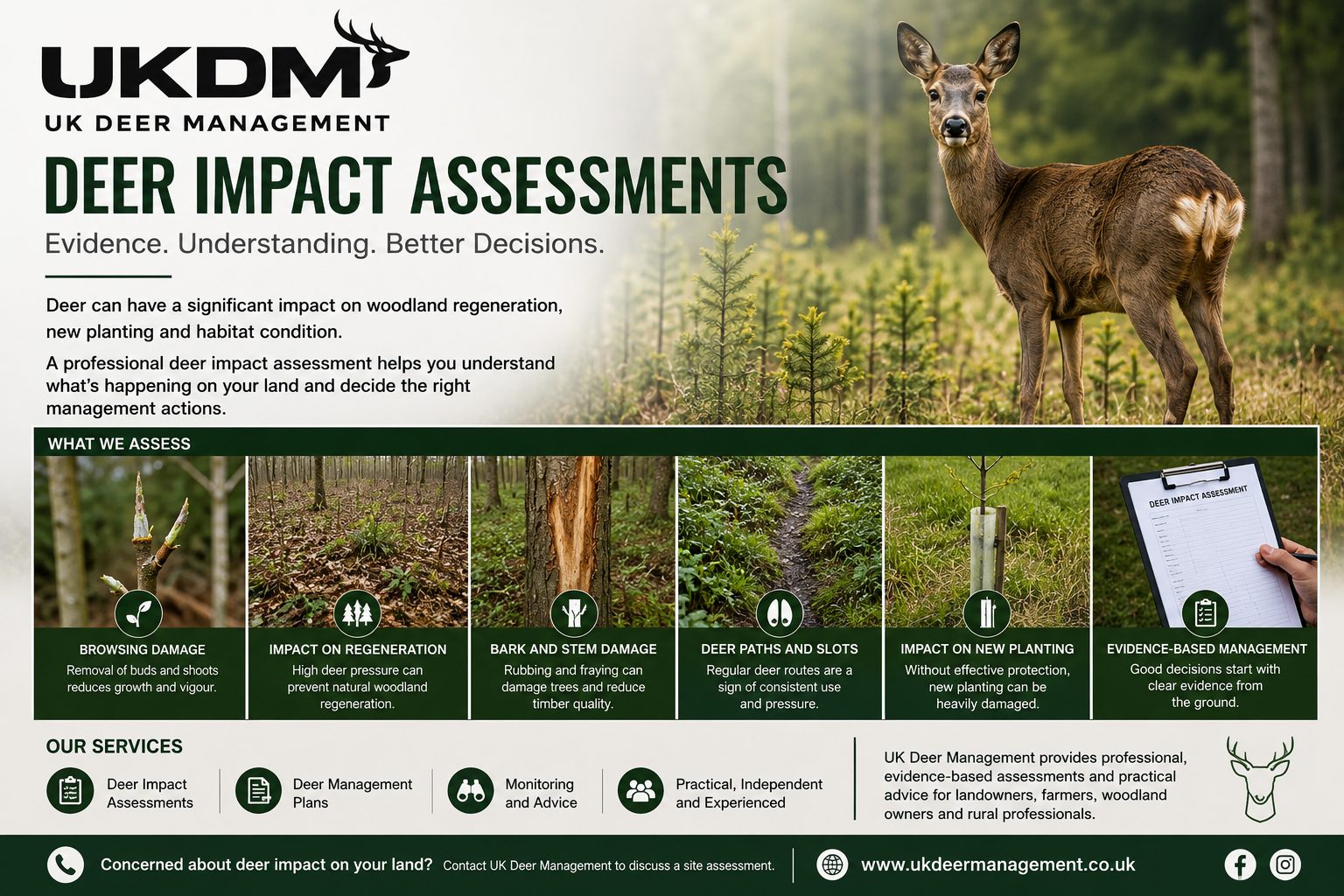
Where deer numbers are not in balance with the habitat, browsing can affect young trees, coppice regrowth, ground flora and woodland regeneration. In some situations, deer impact can also affect new planting schemes, natural regeneration and long-term woodland resilience.
A deer impact assessment helps landowners understand what is happening on the ground before deciding what action is needed.
What is a deer impact assessment?
A deer impact assessment is a site-based review of how deer are affecting woodland, planting, crops or habitat condition.
It may consider:
- Evidence of browsing on young trees and shrubs
- Damage to coppice regrowth
- Fraying or bark damage
- Deer slots, paths and resting areas
- The condition of natural regeneration
- Pressure on new planting
- The suitability of existing protection measures
- Whether current deer management is proportionate and effective
The purpose is not simply to count deer. The key question is whether deer are having an unacceptable impact on the land management objectives for the site.
Why landowners should assess deer impact
Deer management should be based on evidence.
Without an assessment, it can be difficult to know whether poor tree establishment, lack of regeneration or damage to woodland structure is linked to deer, other browsing animals, site conditions, weed competition, disease, drought, or a combination of factors.
A written assessment can help landowners:
- Identify where deer pressure is affecting woodland or crops
- Decide whether a deer management plan is required
- Review whether existing control is working
- Support discussions with contractors, advisers or land agents
- Prioritise vulnerable areas
- Plan future monitoring
Deer management is not only about culling
In some cases, deer control may be necessary. In others, fencing, guards, monitoring, changes to planting strategy or improved coordination between neighbouring landholdings may also be relevant.
Good deer management should be proportionate, lawful and linked to clear objectives.
UK Deer Management
UK Deer Management provides deer impact assessments, deer management planning and practical advice for landowners, farmers, woodland owners and rural professionals.
Our work is based on field evidence, site objectives and practical land management experience.
If you are concerned about deer impact on woodland, crops or habitat condition, contact UK Deer Management to discuss a site assessment.