

Fallow Deer (Dama dama)
FALLOW DEER IN THE UK
Fallow deer (Dama dama) are widespread across England and Wales and are well established in many lowland areas. They are best described as non-native but naturalised and are commonly associated with woodland, parkland and farmland.
GENERAL DESCRIPTION
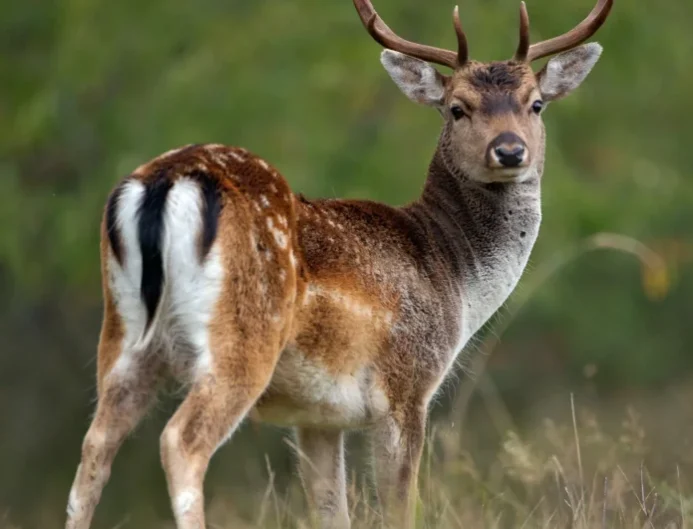
Fallow deer are medium-sized deer with a robust build. Adult bucks typically weigh between 46 and 93 kg, while does weigh between 35 and 56 kg. Bucks are easily recognised by their distinctive palmate (shovel-shaped) antlers, which increase in size and complexity with age. Coat colour is variable, ranging from the familiar spotted chestnut form to darker and melanistic variants, particularly in parkland populations.
LIFESPAN
Fallow deer commonly live around 8 to 10 years in the wild, although some individuals may live longer.
SEXUAL MATURITY
Does can reach sexual maturity from around one year of age and may breed in their second autumn. Bucks mature at a similar age but rarely breed successfully until older, as access to females is typically dominated by larger, more established males.
OFFSPRING
Does typically produce a single fawn each year, although twins can occasionally occur. Fawning success is closely linked to body condition and habitat quality.
GESTATION PERIOD
The gestation period is approximately 230 days, with most fawns born in June and July. Newborn fawns are concealed in vegetation during their early weeks, reducing exposure to disturbance and predation.
HERD SIZE AND SOCIAL STRUCTURE
Fallow deer are highly social and typically live in herds. Groups of 10 to 50 animals are common, although much larger aggregations can occur, particularly in open farmland or parkland. Outside the breeding season, bucks often form separate bachelor groups, while does and young remain in matriarchal groups.
ANNUAL PATTERNS OF BEHAVIOUR
Spring:
Fawning occurs, with does isolating briefly to give birth before rejoining groups. Young deer remain hidden initially before becoming more mobile.
Summer:
Sexes are often separate, with activity focused on feeding and condition building. Deer make full use of available forage, often ranging more widely.
Autumn (Rut):
The rut occurs in October. Bucks establish rutting stands or territories and compete for access to does, engaging in vocalisation, displays and occasional physical confrontation.
Winter:
Herds become more visible, particularly in open farmland. Deer may form larger groups, with feeding activity concentrated where food availability is highest.
DAILY ACTIVITY
Fallow deer are primarily crepuscular, being most active at dawn and dusk. In areas of higher disturbance, they may shift towards more nocturnal behaviour. They frequently move between cover and open feeding areas, particularly along woodland edges.
DIET AND DAILY CONSUMPTION (Equivalent to approx 44 rabbits)
Fallow deer are mixed feeders, grazing and browsing depending on seasonal availability. Their diet includes grasses, agricultural crops, leaves and woody browse. An average fallow deer requires approximately 2.4 kg of dry matter per day, broadly equivalent to around 44 rabbits. Their larger body size means they exert significant grazing pressure, particularly where groups are concentrated.
TYPES OF DAMAGE
Fallow deer can cause significant agricultural and forestry damage, especially where herds are established and unmanaged.
Common impacts include:
•Grazing of crops and pasture, reducing yield and quality
•Browsing of young trees and plantation stock
•Bark stripping and fraying damage in woodland, particularly by bucks
•Concentrated pressure in feeding areas leading to overgrazing and soil impact
Due to their herd behaviour, damage is often localised but severe, with repeated use of the same areas.
SUMMARY
Fallow deer are a widespread, adaptable and well-established species across much of the UK. However, without effective and sustained management, they can exert considerable pressure on farmland, forestry and sensitive habitats. Structured population control is essential to maintain sustainable densities and protect productive land use.
Fallow Deer Management
If Fallow Deer are a problem on your land, please get in touch for a consultation
Newsletters
Subscribe to our newsletter for latest news