




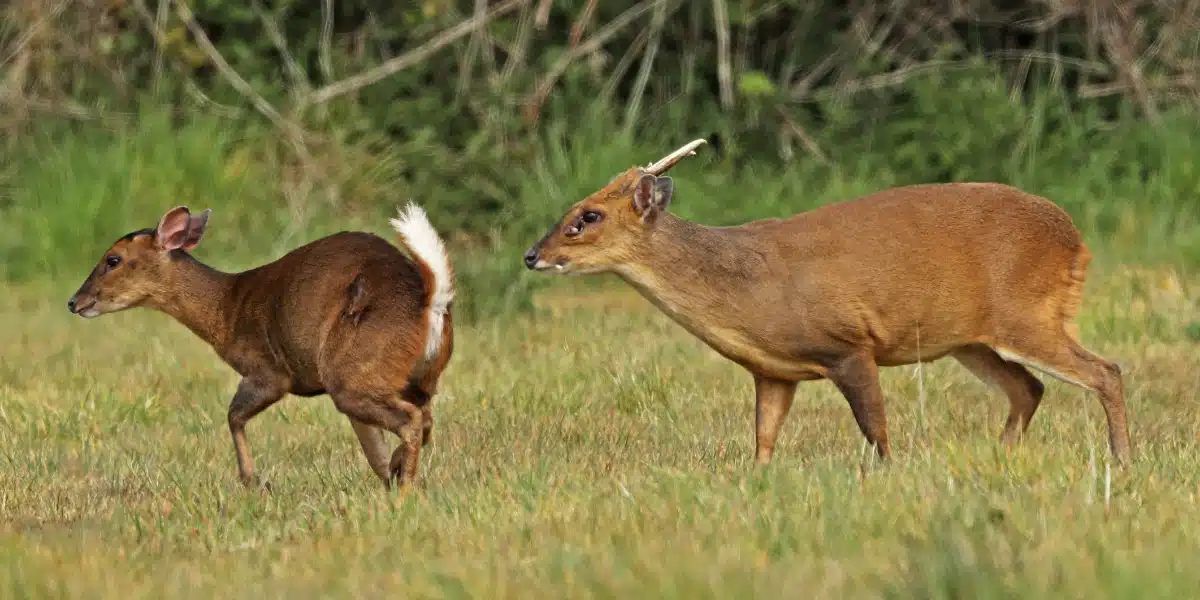
Muntjac Deer (Muntiacus reevesi)
MUNTJAC DEER IN THE UK
Reeves’ muntjac (Muntiacus reevesi) are a non-native, invasive species found mainly in England. They are highly adaptable and thrive in woodland, scrub and farmland.
GENERAL DESCRIPTION
Muntjac are small, compact deer with a characteristic hunched posture and short legs, typically weighing between 9 and 18 kg, with males slightly heavier than females. They have a rich chestnut-brown coat, darker along the back and lighter underneath, with a distinct dark facial stripe. Males are equipped with short antlers set on long, backward-sloping pedicles and elongated upper canine tusks used in territorial disputes. Well adapted to dense woodland and scrub, their size and agility allow them to move easily through thick cover. Unlike native UK deer species, muntjac breed year-round rather than seasonally, contributing to rapid population growth, and are generally solitary and territorial rather than herd-forming.
LIFESPAN
Muntjac may live up to around 10–13 years in the wild.
SEXUAL MATURITY
Does can reach sexual maturity from around seven months of age, and in favourable conditions may conceive shortly thereafter. This early maturity, combined with their ability to breed throughout the year, contributes significantly to rapid population expansion. Bucks typically reach sexual maturity at a similar age, although successful breeding is often influenced by territorial status and dominance rather than age alone.
OFFSPRING
Muntjac usually produce a single fawn, although twins are occasionally recorded. In favourable conditions, does can conceive again shortly after giving birth, resulting in a continuous breeding cycle rather than a defined season. This high reproductive efficiency, combined with early sexual maturity, allows populations to establish and expand rapidly where conditions are suitable.
GESTATION PERIOD
The gestation period is approximately 210 days.
HERD SIZE AND SOCIAL STRUCTURE
Muntjac are solitary and strongly territorial, with no defined herd structure. Adults typically maintain and defend small, overlapping territories, particularly bucks, which will actively exclude rivals through scent marking and, if necessary, physical confrontation. Does are also largely independent, coming together with males only for brief periods during mating, and otherwise remaining alone with their dependent young.
ANNUAL PATTERNS OF BEHAVIOUR
Muntjac breed throughout the year with no defined rut or calving season, unlike native UK deer species. As a result, all stages of the breeding cycle—mating, pregnancy and dependent young—can be encountered at any time of year. This continuous cycle leads to overlapping generations within the population and removes any natural pause in recruitment, contributing to steady and sustained population growth where conditions allow.
DAILY ACTIVITY
Muntjac are active throughout the day, with peaks of movement typically occurring at dawn and dusk. However, in areas subject to regular disturbance or human activity, they often adopt more nocturnal behaviour, becoming increasingly active during hours of darkness. They make frequent use of dense cover, emerging to feed before quickly returning to sheltered areas, which can make them difficult to observe despite their presence.
DIET AND DAILY CONSUMPTION (Equivalent to approx 15 rabbits)
Muntjac are highly adaptable browsers, feeding on a wide range of vegetation including shoots, leaves, herbs, brambles, tree seedlings and agricultural crops. They show a strong preference for tender, nutritious growth, often targeting regenerating woodland and newly established planting. An average muntjac requires approximately 0.8 kg of dry matter per day, and their selective feeding behaviour can have a disproportionate impact on sensitive habitats, particularly where populations are unmanaged.
TYPES OF DAMAGE
Muntjac can cause continuous damage due to their year-round activity, with no seasonal reduction in feeding pressure. Unlike native deer species, their non-seasonal breeding cycle results in a constant presence of feeding animals within a given area.
Common impacts include:
- Browsing of woodland understorey, suppressing natural regeneration and reducing plant diversity
- Damage to young trees and newly planted woodland, often leading to poor establishment or complete failure
- Significant impact on coppice systems, where repeated browsing prevents regrowth and undermines long-term management
- Ongoing pressure on agricultural crops, gardens and amenity planting
Their selective feeding behaviour targets the most palatable and productive growth, which can alter woodland structure over time. Combined with their continuous breeding cycle and territorial nature, this makes populations particularly persistent and difficult to control without sustained management.
SUMMARY
Muntjac are a widespread invasive species. Their year-round breeding and feeding behaviour can lead to persistent damage.
Ongoing management is essential to limit their impact.
Muntjac Deer Management
If Muntjac Deer are a problem on your land, please get in touch for a consultation
Stay Informed
Receive occasional updates on deer management and legislation changes
Professional Deer Management
Professional service you can trust